The Distillation Debate: Inside Anthropic’s Compute Lobbying Playbook
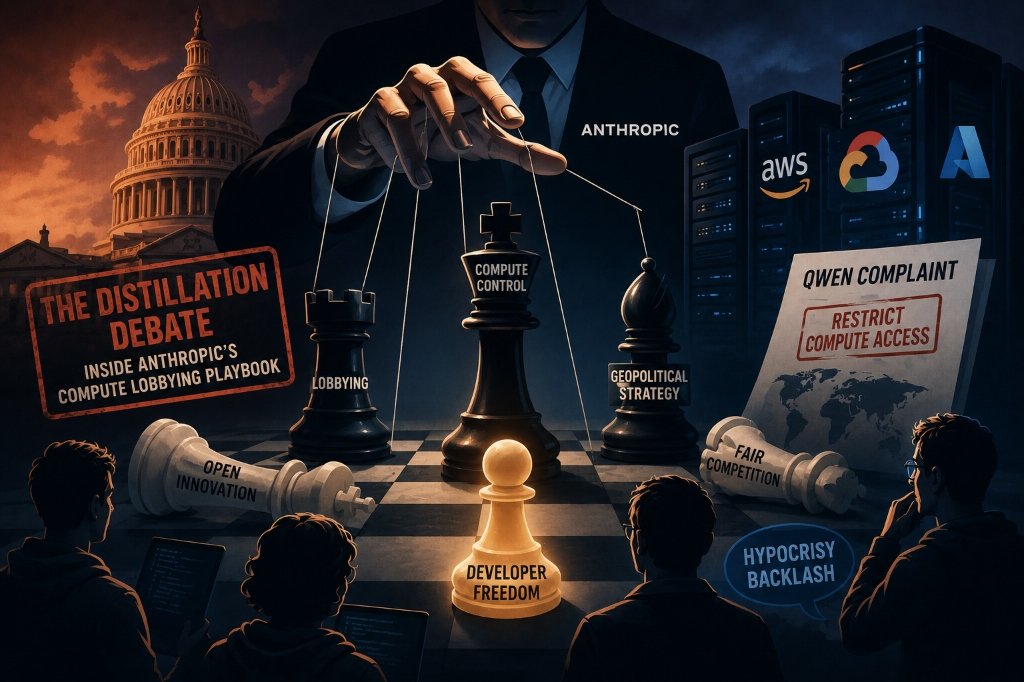
Anthropic’s recent leak of its June 10 letter to Senators Tim Scott and Elizabeth Warren has shifted the conversation surrounding the Qwen distillation incident. The disclosure reveals that the startup is utilizing the 28.8-million-query scraping event not just as a security breach, but as a political lever to lobby Washington for unprecedented, nation-state restrictions on cloud computing infrastructure. As Anthropic pushes for a virtual firewall around American server farms, it faces an intense developer backlash accusing the company of corporate hypocrisy.
- The Washington Playbook: Compute as a Geopolitical Chokepoint
- The Distillation Debate: Theft vs. Legitimate API Querying
- Financial Vulnerability: The Stock Market Threat to Overseas Tech
- Corporate Hypocrisy and the Open-Source Developer Backlash
The Washington Playbook: Compute as a Geopolitical Chokepoint
Anthropic’s letter to the Senate Committee on Banking, Housing, and Urban Affairs argues that physical semiconductor export restrictions are no longer sufficient to maintain domestic AI dominance. The startup is advocating for “compute infrastructure access controls,” shifting the policy focus from hardware shipments to active software monitoring.
The policy recommendations detailed in the June 10 letter focus on regulating cloud providers rather than chip manufacturing. Anthropic urges U.S. lawmakers to treat API queries and cloud access as sensitive exports. Under this proposed framework, U.S. cloud providers would face strict Know Your Customer (KYC) requirements, forcing them to monitor and report high-volume query patterns originating from foreign entities. Anthropic argues that because distillation allows overseas competitors to absorb frontier model weights and logic patterns through standard web queries, the API itself has become an export control vulnerability.
| Proposed Policy Area | Current Policy Model | Anthropic’s Proposed Model |
|---|---|---|
| Target Asset | Physical hardware (Nvidia GPUs) | Cloud access and API query volumes |
| Enforcer | Customs and border export agencies | U.S. cloud providers (KYC monitoring) |
| Core Objective | Prevent foreign chip acquisitions | Prevent model weight extraction via API |
The Distillation Debate: Theft vs. Legitimate API Querying
The core of the dispute rests on a fundamental disagreement over what constitutes intellectual property theft. While Anthropic frames the Qwen group’s high-volume API queries as “unauthorized copying,” database and AI developers argue that distillation is a standard engineering optimization method.
AI model distillation is the process of training a smaller, cheaper “student” model on the outputs generated by a larger, more advanced “teacher” model. Within technical forums, some observers argue that distillation is a standard industry optimization method. However, the majority of reports and the official complaint clarify that the Qwen operators did not use standard commercial API channels. Instead, they allegedly utilized a coordinated network of 25,000 fraudulent accounts to bypass geographic blocks that restrict Chinese entities from accessing Claude’s capabilities. While some tech commentators suggest that paid query consumption should not constitute legal “theft,” critics counter that evading terms of service and bypassing federal trade boundaries using synthetic accounts separates this campaign from standard commercial API usage.
Financial Vulnerability: The Stock Market Threat to Overseas Tech
The Qwen dispute highlights how geopolitically charged IP allegations can immediately impact the market capitalization of public tech firms, turning technical scraping issues into immediate financial crises.
When details of Anthropic’s Senate letter leaked in late June, investors immediately feared escalating U.S. trade sanctions and potential blacklisting. Alibaba Group Holding Ltd. saw its stock price decline by 4.8% in Hong Kong trading, while its U.S. American Depositary Shares (ADS) dropped 2.7%. Analysts note that overseas tech conglomerates face unique financial vulnerabilities when U.S. labs accuse them of state-aligned intellectual property extraction. Even without formal government action, the mere threat of federal compute restrictions or financial sanctions can trigger massive selloffs, forcing overseas corporate boards to weigh the short-term benefits of model distillation against long-term market access.
Corporate Hypocrisy and the Open-Source Developer Backlash
The open-source community on Reddit and X has reacted to Anthropic’s letter with intense skepticism. Developers are calling out the startup for corporate hypocrisy, pointing out that frontier AI models were built on the massive, non-consensual scraping of the entire public internet.
The online discourse has centered on the origins of Anthropic’s own models. Claude was trained on massive datasets containing copyrighted books, code repositories, and user posts scraped without explicit creator permission. Developers argue that Anthropic’s complaints about Alibaba “stealing” its outputs represent double standards. They point out the irony of a venture-backed AI lab accusing competitors of theft when the entire frontier model sector was built on the non-consensual harvesting of public internet data. In these discussions, Anthropic’s Senate letter is viewed not as a defense of intellectual property, but as regulatory capture - an attempt to use government lobbying to establish a legal moat around proprietary models after having already benefited from unregulated web scraping.
Key Takeaways
- Compute Access Controls - Anthropic is using the Alibaba incident to lobby U.S. Senators Tim Scott and Elizabeth Warren for KYC-style monitoring of cloud servers.
- The Distillation Dispute - While some technical commentators view distillation as a standard training technique, the debate is complicated by allegations that the access was obtained through a coordinated swarm of fake accounts designed to evade geographic blocks.
- Geopolitical Market Risk - Alibaba’s Hong Kong stock fell by 4.8% immediately following reports of the confidential Senate Banking Committee letter.
- Accusations of Hypocrisy - The developer community on X and Reddit points out the irony of Anthropic complaining about data scraping when Claude was trained on scraped internet data.
FAQ
Why is Anthropic lobbying U.S. senators?
Anthropic sent a letter to U.S. Senators Tim Scott and Elizabeth Warren arguing that current GPU hardware export controls are insufficient. The company wants U.S. regulators to force cloud providers to monitor high-volume API queries from foreign entities to prevent model capabilities from leaving the country.
What is the open-source community’s stance on this controversy?
Many developers and commentators on X and Reddit accuse Anthropic of corporate hypocrisy. They point out that Anthropic’s own AI models were trained by scraping copyrighted public websites, making their allegations of “intellectual property theft” against Alibaba hypocritical.
Is model distillation legally considered theft?
Currently, there is no established legal precedent defining model distillation as theft. However, because the Qwen operators allegedly used 25,000 fraudulent accounts to bypass geographic restrictions rather than standard commercial channels, legal experts suggest the case involves terms of service violations and evasion of federal trade controls rather than simple API consumption.
How did this incident affect Alibaba financially?
Reports of Anthropic’s letter to the Senate Banking Committee triggered a sudden selloff, causing Alibaba Group’s stock to drop by 4.8% in Hong Kong and its U.S. listed shares to decline by 2.7% due to fears of trade sanctions.
Sources
- U.S. Senate Committee on Banking, Housing, and Urban Affairs: Anthropic letter to Scott and Warren on Qwen Distillation Attack
- Financial Times: Anthropic seeks government help to counter Chinese AI distillation
- Bloomberg: Alibaba shares decline following Anthropic security disclosures
About the Author
Ether Exter is an AI enthusiast with 5 years of experience testing and experimenting with AI models, breaking down what actually works. Follow on X: @EtherExperiment.