
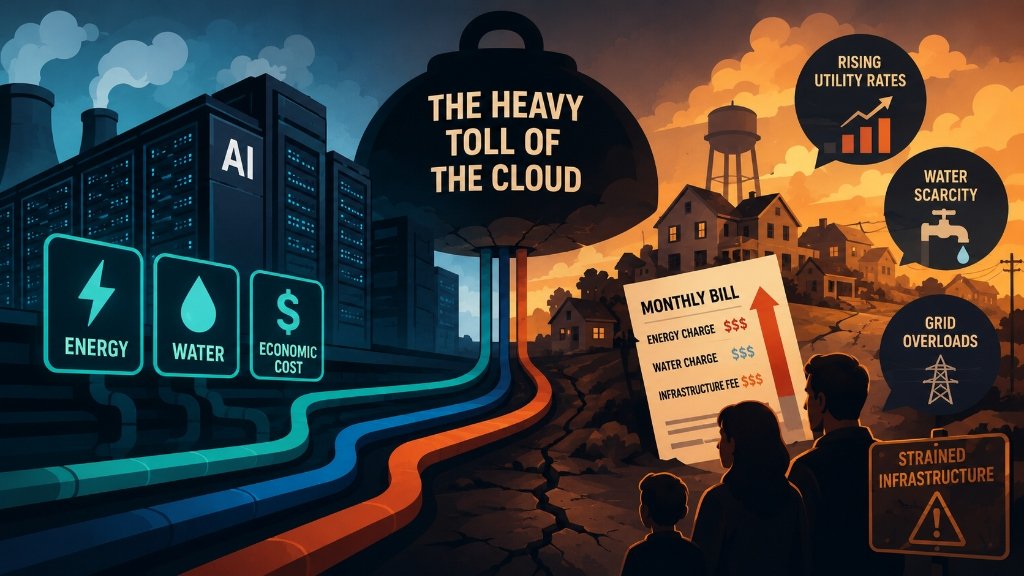
The Heavy Toll of the Cloud: How AI Data Centers Strain Local Communities
This article analyzes the material realities of generative artificial intelligence infrastructure. Behind the seamless interfaces of agentic coding assistants and large language models lies a rapidly expanding network of physical data centers that place significant strain on local grids, water resources, and consumer utility bills.
The Physical Cost of Digital Intelligence
The transition from traditional cloud computing to generative artificial intelligence has altered the resource requirements of modern data centers. While standard web hosting and database storage require consistent but moderate power, training and running large language models requires dense clusters of graphics processing units. These specialized chips operate at high temperatures, consuming several times the electricity of standard servers and requiring advanced cooling infrastructure.
This expansion has created a timing mismatch between technological deployment and public infrastructure planning. A technology company can build a state-of-the-art data center in less than two years. However, building the high-voltage transmission lines, substations, and power generation facilities required to support that facility can take a decade or more. This mismatch has left local communities caught between the immediate power demands of the artificial intelligence industry and the slow cycle of public utility expansion.
As developers continue to deploy advanced agents and integrate AI into everyday workflows (such as terminal-agent workflows and vibe coding systems), the broader industry must reckon with the physical infrastructure that supports these tools. To understand this impact, we must look beyond abstract computing power and examine the concrete resource consumption of local facilities.
The Water Footprint Mismatch: The Case of The Dalles
One of the most immediate impacts on local communities is the volume of water required to keep data center chips cool. Most data centers rely on evaporative cooling systems, which evaporate water to lower the temperature of the air inside the facility. This method is highly energy-efficient but consumes large amounts of water.
The scale of this local resource consumption was highlighted in a legal battle in Oregon. In 2021, the city of The Dalles filed a lawsuit against the local newspaper The Oregonian to block the public disclosure of Google’s water consumption records, arguing that the figures were trade secrets protected by non-disclosure agreements. In December 2022, the city settled the 13-month lawsuit and released the records.
According to the disclosed documents, reported by Oregon Public Broadcasting, Google’s annual water consumption in The Dalles grew from 104 million gallons in 2012 to 434 million gallons in 2024. This consumption now represents approximately 30% to 40% of the entire water supply of The Dalles, a region severely affected by ongoing agricultural droughts and ecological strain on the Dog River watershed, which serves as a critical cold-water habitat for protected fish.
A primary technical analysis published by the Wall Street Journal revealed that AI data centers use significantly more water than technology giants report in their high-level environmental disclosures. The gap between corporate reporting and local water consumption has created friction in regions prone to water scarcity. While companies often publish global efficiency metrics, such as water usage effectiveness, the local impact remains highly concentrated.
Grid Capacity and the Shifting Cost of Power
The electricity demands of AI data centers represent an unprecedented challenge for grid operators. Modern data center campuses can require hundreds of megawatts of power, with some planned facilities projected to reach gigawatt scale. This concentrated load can exceed the capacity of local transmission lines and distribution networks.
The regulatory response in Georgia highlights this capacity dispute. In December 2025, the Georgia Public Service Commission approved a plan for Georgia Power to add approximately 10,000 megawatts of new generation capacity (nearly a 50% capacity expansion) to meet the electricity demand driven almost entirely by new AI data centers.
This capacity bottleneck has direct financial consequences for ordinary citizens. Consumer advocates, including the Southern Environmental Law Center, have protested that the projections for data center demand are speculative. They warn that if these data centers do not materialize or scale back, existing residential customers will be left paying for the multi-billion-dollar cost of the massive new energy infrastructure.
A report by the Wall Street Journal indicates that the data center boom is contributing to a rise in residential electricity rates, shifting the cost of industrial upgrades onto local ratepayers. To protect consumers, the Georgia Public Service Commission had to implement minimum billing requirements and longer contract terms in January 2025 to ensure data centers continue to pay for infrastructure even if they leave the state, but concerns about rate increases remain high.
Google’s Emissions Dilemma
The challenge of balancing infrastructure growth with resource conservation is visible in Google’s 2026 Environmental Report, which covers performance for the 2025 fiscal year. The report reveals a nuanced picture of operational efficiency versus supply chain growth.
On one hand, Google achieved a 2% reduction in operational emissions (Scope 1 and market-based Scope 2) in 2025 compared to 2024. The company attributed this success to its clean energy procurement program, signing agreements for over 12 gigawatts of net-new clean energy in 2025 alone.
On the other hand, Google experienced its largest-ever increase in electricity demand, which rose 37% in 2025 compared to the prior year. Since 2019, Google’s electricity demand has increased by more than 250%. Furthermore, Google’s Scope 3 emissions (which include the supply chain, AI hardware manufacturing, and data center construction) rose separately, with data center construction alone accounting for 2.3 million metric tons of carbon dioxide equivalent (tCO2e) in 2025, representing nearly one-fifth of Google’s total Scope 3 footprint.
The discrepancy highlights the difficulty of scaling energy-hungry computing clusters while relying on a grid that is still largely powered by fossil fuels. To maintain operations when the grid is strained, many data centers rely on large arrays of diesel backup generators. These generators release particulate matter and nitrogen oxides into the local air, posing health risks to nearby residential communities.
Technical Analysis: Local vs. Cloud-Based Model Inference
To understand why AI demands so much resource consumption, we can perform a technical comparison of local execution versus cloud-based API calls.
When a developer runs a query on a local machine, the energy consumed is limited to the local hardware. For example, running a local model like Llama-3-8B on an Apple Silicon M3 Max processor consumes approximately 30 to 40 watts under full load. A typical text generation takes about 1.5 seconds, resulting in an energy expenditure of roughly 0.015 watt-hours (Wh) per query.
In contrast, sending the same query to a cloud-based API cluster of Nvidia H100 graphics processing units requires a massive infrastructure overhead. A single H100 GPU can consume up to 700 watts at peak, and these chips are deployed in interconnected nodes that process requests in parallel. When accounting for network routing, data transmission, and the power usage effectiveness (PUE) overhead of data center cooling systems, a single cloud-based LLM query consumes between 3 to 10 watt-hours of energy.
| Metric | Local Inference (M3 Max / Llama-3-8B) | Cloud Inference (H100 Cluster / Cloud API) |
|---|---|---|
| Peak Power Draw | ~35 Watts | ~700 Watts (per GPU) |
| Execution Time | ~1.5 Seconds | ~1.0 Second |
| Energy per Query | ~0.015 Wh | ~3.0 to 10.0 Wh |
| Water Overhead | 0 Gallons (Direct) | Evaporative cooling at facility |
This comparison reveals that cloud-based API queries consume up to 200 to 600 times more total system energy than running an optimized local model. When scaled across billions of queries daily, this efficiency gap explains why hyperscalers are experiencing unprecedented surges in grid demand.
The Friction of Local Coexistence
The combination of rising utility rates, water depletion, and environmental impact has created local resistance to data center zoning and construction. In several municipalities, residents have organized to protest new zoning permits, citing noise pollution from industrial cooling fans, the destruction of local green spaces, and the lack of long-term job creation.
Unlike manufacturing plants or fulfillment centers, data centers are highly automated. Once constructed, a facility requiring hundreds of megawatts of power may employ fewer than fifty full-time workers. For local communities, the trade-off is often unfavorable: they absorb the physical noise, environmental strain, and utility rate increases of the facility, while the high-paying engineering jobs are concentrated at the technology firm’s headquarters.
This dynamic has led to regulatory pushback. Some local governments are implementing stricter water-use regulations and noise limits on data center cooling systems. Others are proposing that technology companies fund their own dedicated power generation facilities rather than drawing from the public grid.
This trend is prompting tech firms to explore alternative energy strategies. Some companies are investing in dedicated nuclear power agreements or geothermal energy projects to secure a reliable source of electricity without waiting for public grid upgrades. However, these solutions are capital-intensive and years away from widespread deployment, leaving local grids to bear the immediate burden of the AI buildout.
Balancing Technological Growth and Public Interest
The controversy surrounding AI data centers demonstrates that digital intelligence is bound to physical limits. The convenience of running complex machine learning queries in the cloud depends on the resources of the communities where data centers are built.
To establish a sustainable path forward, regulatory frameworks must ensure that technology companies pay the full cost of their infrastructure footprint. This includes funding dedicated power generation, investing in closed-loop water recycling systems, and protecting ratepayers from cost-shifting. Without these protections, the expansion of artificial intelligence will continue to create friction, placing the material costs of the digital revolution on local residents.
Managing this footprint is not just an environmental goal; it is a requirement for maintaining the public trust necessary for the long-term adoption of AI technology.
Ether Exter is an AI enthusiast with 5 years of experience testing and experimenting with AI models, breaking down what actually works. Follow on X: @EtherExperiment.
Sources
- Resource Allocation and Local Impact: Wall Street Journal - AI Data Centers Water Use
- Economic Ratepayer Impact: Wall Street Journal - Data Center Boom Sparks Inflation
- Water Litigation and Settlement: Oregon Public Broadcasting - The Dalles Drops Lawsuit Against The Oregonian
- Corporate Environmental Metrics: Google 2026 Environmental Report