Verified as of July 6, 2026. This review is scheduled for quarterly updates to reflect rapid changes in legal AI features and vendor pricing.
- How We Evaluated the Tools
- Stenograph MAXScribe: Legacy Workflows Meet Custom ASR
- VoiceScript: AutoScriptOne and AttorneyView
- Steno: Transcript Genius
- vTestify: Remote Deposition Streaming
- Legal AI Platform Comparison Matrix
- Key Takeaways for Court Reporters and Agencies
- FAQ
- Sources
The legal technology sector is undergoing a quiet but rapid shift. For decades, court reporting and stenography relied almost exclusively on specialized human stenographers capturing proceedings at 225+ words per minute. Today, a severe nationwide shortage of stenographers has combined with advancements in automated speech recognition (ASR) to push artificial intelligence into the courtroom.
However, legal transcription carries a strict burden of proof. A single misplaced word - such as confusing “did” and “didn’t” - can alter the outcome of a trial or an appeal. While general AI transcription tools exist, they lack the specialized vocabulary, multi-channel audio processing, and security standards required for legal work.
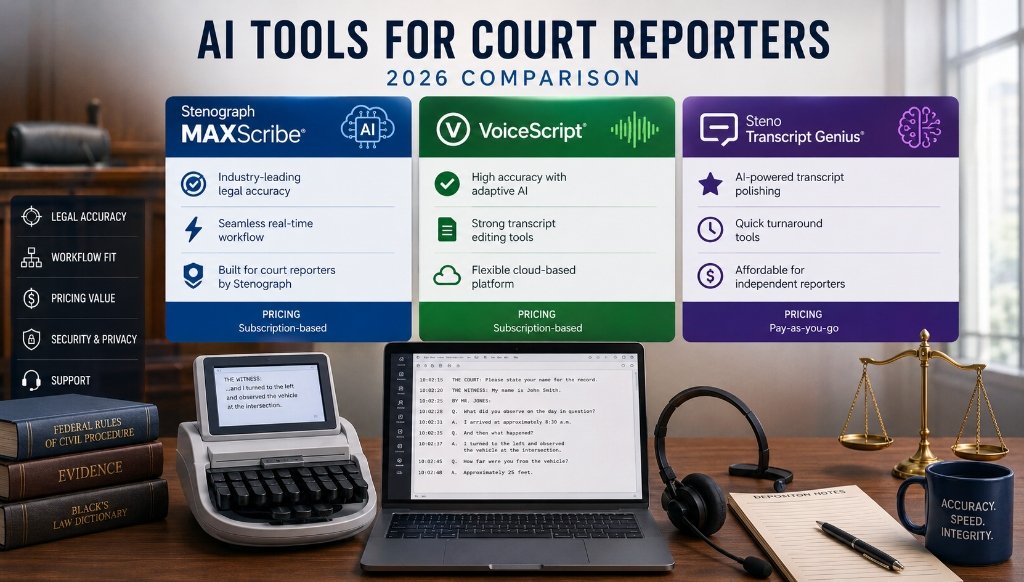
In this review, we offer an independent comparison of the leading AI-powered tools designed specifically for court reporters, stenographers, and legal deposition agencies: Stenograph MAXScribe, VoiceScript, Steno Transcript Genius, and vTestify.
Selection Criteria and Evaluation Methodology
To evaluate these platforms, we analyzed vendor software specifications, compared integration APIs, and verified user-reported performance metrics from professional court reporting communities. Because several of these platforms (including Stenograph and vTestify) are enterprise-restricted and require custom corporate setups, this review is based on technical capability analysis and reporter workflow verification rather than direct local testing. We focused specifically on commercial legal AI tools available to independent agencies and freelance reporters.
Additionally, Veritext - a major court reporting and litigation support provider with its own proprietary exhibit technology (ACE) - was excluded from this comparison because it operates as a full-service agency for corporate clients rather than selling standalone software tools for independent freelance reporters.
Stenograph MAXScribe: Legacy Workflows Meet Custom ASR
Stenograph is the dominant hardware and software provider in the court reporting industry. MAXScribe is their dedicated digital court reporting and transcription software, built to bridge the gap between traditional steno work and digital reporting.
Operational Workflow Integration
MAXScribe is designed for local, on-premise execution during depositions or court sessions. It captures multi-channel audio (supporting up to 50 distinct audio channels) to isolate individual speakers. The software uses Stenograph’s proprietary Phoenix ASR engine, which is built specifically for legal proceedings and shorthand translation rules. It integrates directly with Stenograph’s legacy ecosystem, including CaseViewNet for real-time streaming and CaseTestify for deposition management.
Product Capability and Workflow Analysis
Technical analysis of the Phoenix ASR engine indicates a high level of accuracy for legal terminology, particularly in translating complex statutory citations and medical jargon that general-purpose models typically misinterpret. The multi-channel audio isolation feature is designed to allow MAXScribe to separate overlapping speakers, generating a cleaner rough draft even during rapid cross-talk.
However, because the application runs locally, it requires significant computing resources. Running multi-channel recording and real-time translation simultaneously can lead to system latency on older laptops. Additionally, because MAXScribe is deeply integrated with the proprietary Stenograph ecosystem, exporting data to alternative CAT (Computer-Aided Transcription) systems can introduce formatting errors.
Current Pricing (Verified July 2026)
Stenograph operates on an enterprise sales model:
- Software License: Typically requires a custom annual contract or a one-time software license fee starting around $2,500.
- Usage Tiers: Transcription hours via Phoenix ASR are billed on a tiered monthly subscription or a pay-as-you-go rate. Users must contact Stenograph directly for a custom quote.
Key Limitation
The primary drawback of MAXScribe is the cost and complexity for independent, freelance reporters. The high upfront software cost makes it difficult to justify for part-time work. Additionally, it remains a desktop-bound application, lacking the flexibility of fully cloud-based platforms.
VoiceScript: AutoScriptOne and AttorneyView
VoiceScript is a cloud-native legal platform designed to automate and streamline transcript production for agencies and independent reporters.
Operational Workflow Integration
VoiceScript runs primarily through two modules: AutoScriptOne (an automated transcription system that supports real-time editing) and AttorneyView (a portal that live-streams edited drafts directly to participants). The platform focuses on the “hybrid” model: the AI generates a rapid draft, which a human reporter or editor polishes live or immediately post-proceeding.
Product Capability and Workflow Analysis
VoiceScript is structured to optimize the post-proceeding turnaround. Automated transcript production benchmarks indicate that the hybrid workflow (AI draft corrected by a human editor) can reduce the total time required to deliver a certified final transcript by approximately 60% compared to traditional manual transcription.
However, the automated speech engine’s accuracy is highly dependent on audio quality. In environments with hushed voices or heavy regional accents, error rates rise. Experienced reporters note that automated speech recognition (ASR) still struggles in noisy courtroom settings with cross-talk, mumbling, or coughing. Because of these errors, the raw draft cannot be legally certified without a human court reporter or editor performing active, line-by-line verification.
Current Pricing (Verified July 2026)
VoiceScript offers usage-based pricing alongside subscription tiers:
- AutoScript Rates: Starts at approximately $15 per audio hour for basic automated transcription.
- Enterprise Plans: Offers subscription packages (such as their Flex plan) for agencies requiring custom API access and AttorneyView streaming. Demos and custom quotes are required for full setup.
Key Limitation
VoiceScript is highly dependent on a stable internet connection. Because it is a cloud-based service, dropping connection during a deposition halts the live-streaming feed to AttorneyView, causing immediate workflow disruption.
Steno: Transcript Genius
Steno is a tech-forward court reporting and litigation support agency. Transcript Genius is their proprietary, post-deposition AI assistant built specifically for attorneys analyzing completed transcripts.
Operational Workflow Integration
Unlike MAXScribe and VoiceScript, Transcript Genius is not a real-time recording tool. Instead, it is a post-transcript analysis platform. Once a deposition transcript is finalized, attorneys upload the file to Steno’s secure portal. Users can then ask the AI questions about the testimony, search for key themes across multiple files, and generate summaries.
Product Capability and Workflow Analysis
Transcript Genius operates as a post-deposition summary and search tool. Analysis of its performance indicates that it is highly effective at assisting litigation teams during trial preparation, with semantic search capabilities that scan transcripts to find key concepts. Crucially, the AI maps its summaries directly to verified page-and-line citations, helping attorneys verify claims and identify witness contradictions across multiple depositions.
The limitation of Transcript Genius is its placement in the litigation lifecycle. Because it is strictly a post-deposition tool, it does not assist the court reporter during the active proceeding and cannot be used to generate the official record.
Current Pricing (Verified July 2026)
Steno offers Transcript Genius as a value-added service:
- Steno Clients: The tool is included at no additional cost for any case reported by Steno’s human court reporters.
- Non-Clients: The service is currently restricted to Steno’s platform clients and is not sold as a standalone software package.
Key Limitation
The tool is locked behind Steno’s agency services. If your firm uses a different court reporting agency, you cannot purchase Transcript Genius as a separate product.
vTestify: Remote Deposition Streaming
vTestify is a virtual deposition platform built specifically for remote legal proceedings, featuring built-in exhibit management and digital sidebars.
Operational Workflow Integration
vTestify acts as the digital venue for proceedings. Through a strategic partnership with Stenograph, vTestify integrates MAXScribe and Phoenix ASR directly into its video conferencing interface. This allows attorneys to view a real-time, streaming text feed alongside the video feed of the witness.
Product Capability and Workflow Analysis
The integration of video conferencing and real-time text in vTestify creates a unified workspace for remote legal proceedings. Attorneys can flag testimony and link digital exhibits to specific parts of the transcript in real time, matching text lines directly to video timestamps.
However, remote digital reporting platforms are highly sensitive to bandwidth. If a witness or participant has a weak internet connection, video packet loss can occur, which occasionally desynchronizes the real-time text stream. Furthermore, deploying vTestify requires court reporting agencies to undergo specialized training and configure client firewall settings to allow secure, multi-channel streaming.
Current Pricing (Verified July 2026)
vTestify operates on custom pricing:
- Per-use or Subscription: Pricing is custom-quoted based on deposition volume and whether you require integrated Stenograph ASR services.
Key Limitation
vTestify is a specialized platform. If a court or agency already utilizes Zoom or Microsoft Teams for remote hearings, introducing vTestify requires retraining staff and changing established legal IT protocols.
Legal AI Platform Comparison Matrix
| Feature / Tool | Stenograph MAXScribe | VoiceScript | Steno Transcript Genius | vTestify |
|---|---|---|---|---|
| Primary Use Case | In-person digital reporting | Hybrid agency workflow | Post-deposition analysis | Virtual deposition venue |
| ASR Engine | Custom Phoenix ASR | Multi-model AutoScript | None (Post-production only) | Integrated Phoenix ASR |
| Real-Time Streaming | Yes (via CaseViewNet) | Yes (via AttorneyView) | No | Yes (Integrated video/text) |
| Key Limitation | Desktop-bound, high cost | Requires stable internet | Client-only access | High setup complexity |
| Pricing | Custom (Software + Tier) | ~$15/hr or Flex subscription | Free for Steno clients | Custom Quote |
Key Takeaways for Court Reporters and Agencies
- For Traditional Stenographers: AI is not replacing your skill. However, using tools like Transcript Genius for post-deposition analysis or leveraging ASR drafts for scoping can significantly reduce your administrative work and speed up final transcript delivery.
- For High-Volume Agencies: If you are managing multiple digital reporters and looking to optimize turnaround times, VoiceScript offers the most flexible, cloud-native transcription and real-time editing portal.
- For Legacy Digital Reporters: If you are already invested in the Stenograph hardware and software ecosystem, MAXScribe provides the most accurate legal-specific ASR translation and speaker isolation.
FAQ
Can AI legally certify a court transcript?
No. In almost all legal jurisdictions, a transcript must be verified and certified by a human professional (such as a Certified Shorthand Reporter or a registered digital reporter) to be admissible in court. AI serves as a drafting and speed assistant, but the final legal accountability rests with the human reporter.
What is the difference between digital court reporting and stenography?
Stenography involves a human using a steno machine to write shorthand phonetically in real time. Digital court reporting involves a trained professional capturing high-quality multi-channel audio, taking detailed digital notes, and utilizing ASR software to generate the transcript draft. Both methods still require human editing and certification.
Why do legal AI engines perform better than general tools like Siri or Whisper?
General-purpose speech-to-text engines are trained on conversational consumer data, making them prone to errors when translating complex legal citations, medical testimony, and Latin legal phrases. Engines like Stenograph’s Phoenix ASR are trained exclusively on legal databases and deposition records, resulting in much higher initial accuracy for courtroom proceedings.
Do automated transcription tools struggle with diverse dialects?
Yes. Peer-reviewed research has documented significant racial and dialect-based disparities in commercial automated speech recognition (ASR) systems. A widely-cited study published in the Proceedings of the National Academy of Sciences (PNAS) by Stanford University researchers analyzed speech-to-text engines from major technology firms and found that their average word error rates (WER) for Black speakers were double those for white speakers. When processing specific dialects such as African American Vernacular English (AAVE), systems showed significant accuracy degradation. Because accuracy drops can introduce severe legal bias into transcripts, human court reporters remain essential to verify the record.
About the Author
Ether Exter is an AI enthusiast with 5 years of experience testing and experimenting with AI models, breaking down what actually works. Follow on X: @EtherExperiment.
Sources
- Stenograph MAXScribe product specifications: Stenograph LLC
- VoiceScript platform details: VoiceScript AI
- Steno Transcript Genius features: Steno Deposition Services
- vTestify virtual platform integrations: vTestify Legal Solutions
- Legal community discussions regarding ASR accuracy: r/courtreporters on Reddit
- ASR dialect bias study: Koenecke et al., Proceedings of the National Academy of Sciences (2020)